
Murray Wondering
Wonder may just be what’s needed to navigate the controversial Murray-Darling Basin Plan and protect the future of this life-giving river system.

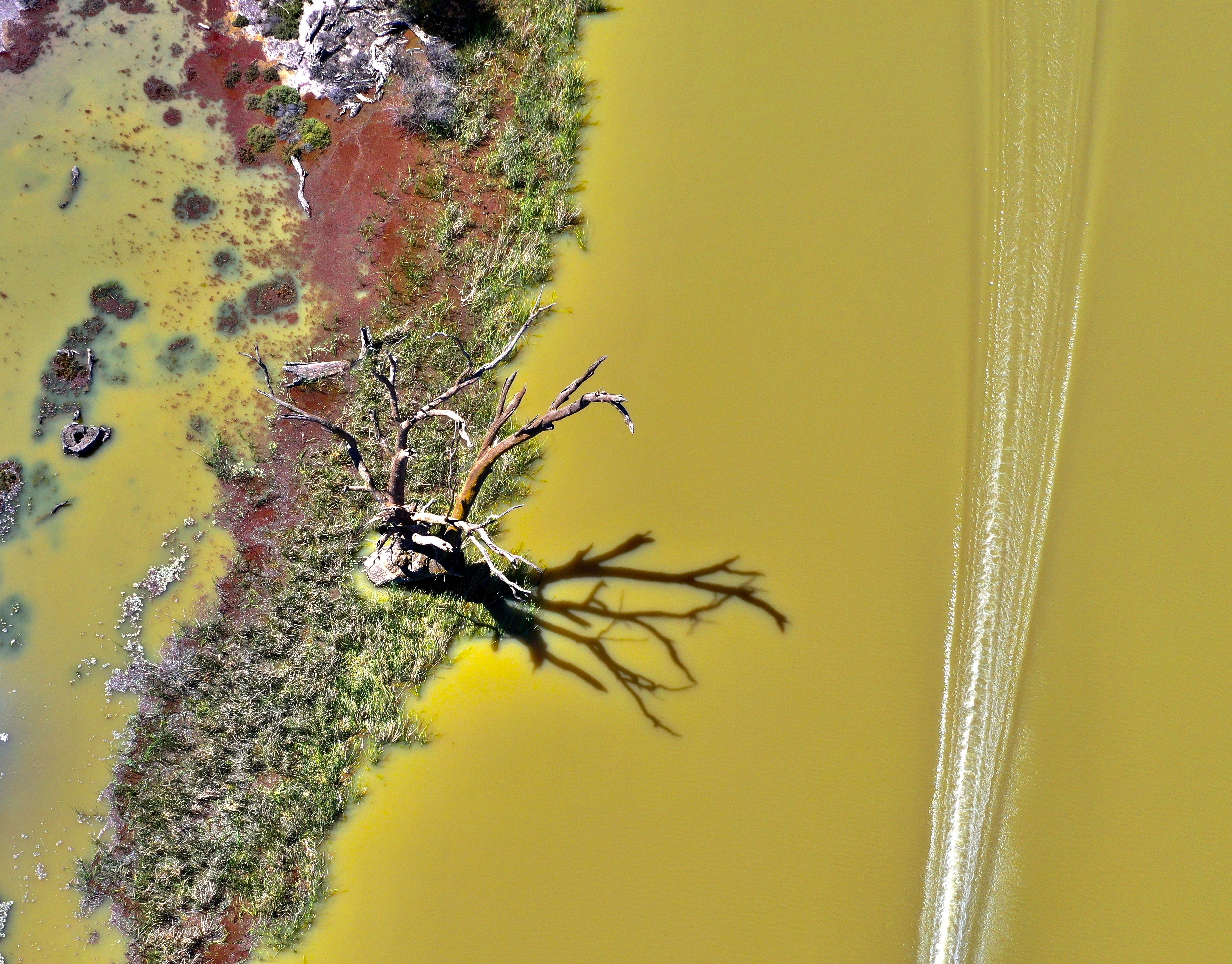
The river is soaked in midday sun and the water is lukewarm on top but below, as cold as if it hadn’t yet travelled 1,384km from its mountain source. This is how I meet the Murray River, swimming through layers of warmth and cool, immersed in an iconically Australian scene. Red river gums line the banks, trunks patterned fawn, pink and shades of browns. Gumleaves shimmering. Whistling kites calling their ancient anthem overhead. Corellas squawking. A puttering tinny. It is wondrous, and in this moment I’m a child drifting with the flow and forgetting where I am and who I am; simply and wholly enjoying the cool and warmth in equal measure.
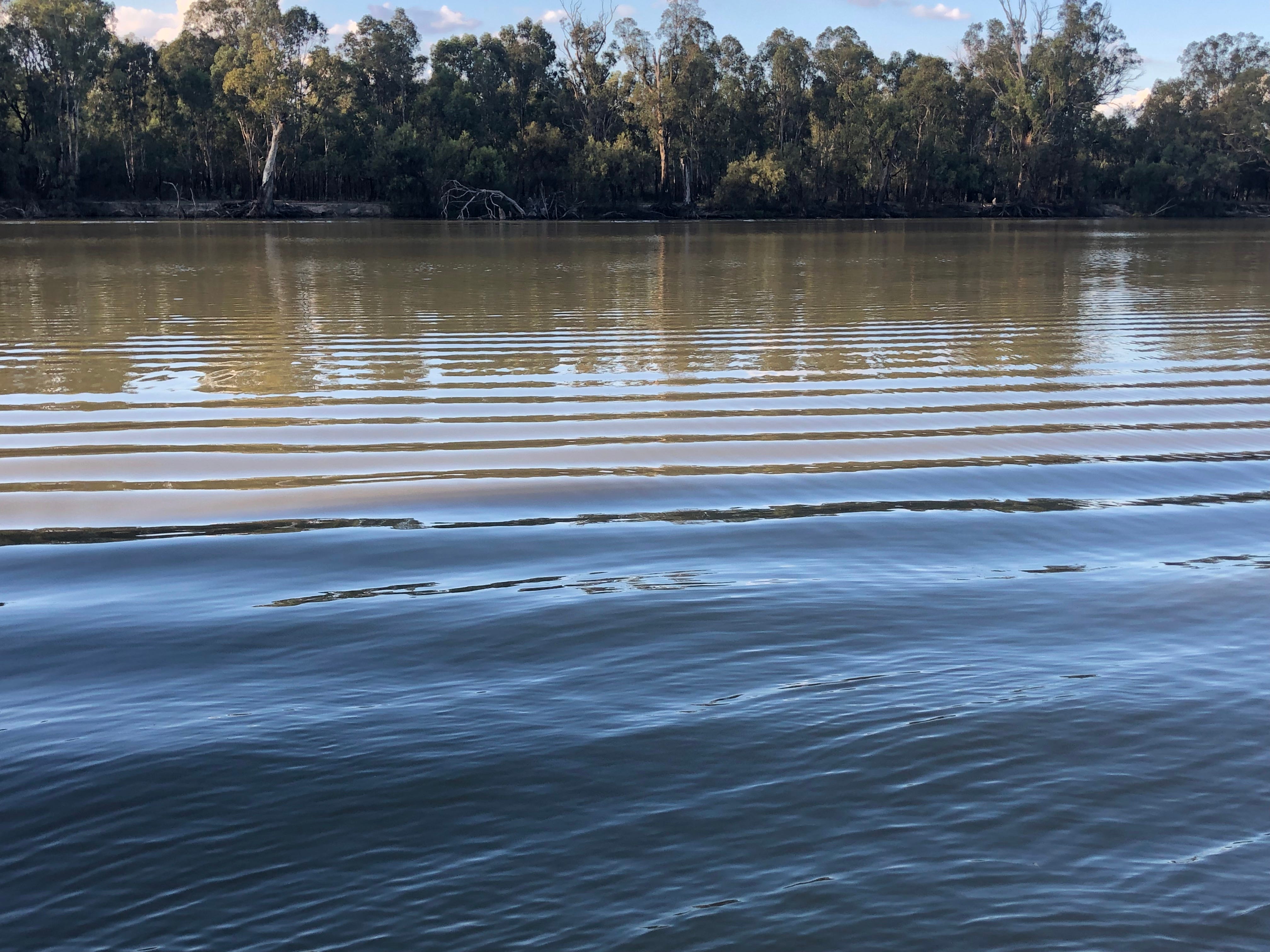
I head out further and tempt myself to go under but notice the murkiness. It is a milky Murray. Thinking about the industry along the river and what might be seeping through my pores, other than H2O, my wondering turns pragmatic. I will spend the next eight days canoeing the Murray and I will think a lot about the turbidity and the troubles of the river, my feelings as mixed as the opaque water’s composition. Around one bend, grief grows from seeing the effects of water extraction, agricultural runoff and reduced flows. Erosion slices the rivers’ banks, leaving tree roots exposed and a simplified ecosystem. Around the next bend, I’m dazzled by the sight and sound of a flock of correllas flying low, the whirring of their wings perfectly calibrated just shy of the water’s surface.
I am here to join a group of scientists, engineers, academics, farmers and storytellers on a journey from Robinvale, a town on the river’s north-west Victoria bank, to the confluence of the Murray and Darling-Baaka rivers. We have gathered for the inaugural Confluence water course, guided by host of The RegenNarration podcast Anthony James, educator and writer Dr Katie Ross, and river guide Thomas Floyd. We share both professional and personal interests in the future of the Murray-Darling Basin and, more broadly, the future of water in this drying continent. But, this week, we are here not to solve problems, only to listen. To ourselves, each other and perhaps to the river itself.
Milky Murray. My metonym for the largest and most complex basin in Australia, which covers around one million square kilometres of eastern Australia and supplies water for a third of the nation’s food. Now is a good time to be thinking about the Milky Murray. The Murray-Darling Basin Management Plan is under review for the first time since Julia Gillard’s government put it in place in 2012. Back then, the Basin was showing signs of severe stress following the Millennium drought and years of overextraction. Parts of the Darling-Baarka River stopped flowing for hundreds of days, soils of the Lower Lakes acidified, over half of red river gums in the Macquarie Marshes died.
While the Plan has helped to curb water extraction and redirect water to the environment, the rage-inducing controversy is legend, with tensions representing a real ecological conundrum. There are competing interests amongst agricultural irrigators, environmentalists, and governments over water buybacks, ecosystem failures, climate change adaptation, and of course the socioeconomic impacts on rural communities. Stakeholders and communities recently had a once-in-a-decade opportunity to have a say in the Basin’s future management. Submissions closed on 1st May and the Murray-Darling Basin Authority will make recommendations for a new management plan before the year is out.
For all the practical mitigation and management principles under consideration, what may not be on the planning table is a plea to wonder more. To sit with uncertainty, to be guided by curiosity and awe, and to imagine beyond the limitations of our current organising principles and ask, what if the Murray-Darling Basin and its communities could flourish?
Perhaps wonder occupies a too distant, too childlike, long-forgotten territory. It has been crowded out by the enduring economic and colonial narrative of nature as a resource. Of course, stories of the river stretch further and are varied and rich. The document Water is Life shares twenty-seven Traditional Owner Nations statements characterising water beyond resource. ‘As Bangerang People we cannot be separated from our water or our Country, we are all one and we are all essential to the health of each other’. Other stories originate in diverse communities living in the Basin and show complex but deep attachments and tenderness. Many are captured in a recent report Voices from the Basin. A former shearer and irrigation contractor, now in his nineties says, ‘Our place was the mecca for all relations – fishing over Christmas out on the Gunbower or the Murray. We used to give them their fishing bait out of the channel – we’d get half a brown bag full of freshwater mussels by just going along with our toes.’
If animal and plant inhabitants, or the river itself could speak, I wonder what stories they would tell, of kinship, abundance, scarcity, loss, survival?
Wonder is a close cousin of story. Both involve evocation and imagination. Both offer inspiration and guidance towards the future. Story can lead to wonder and wonder can lead to story. But wonder requires suspension of the need for certainty, a willingness to not yet know. To wonder is also to feel doubt. In Middle English the word carried a sense of being puzzled or perplexed. The business of the Milky Murray is muddy. Not yet knowing, or admitting to not yet knowing, is unwelcome in a policy environment under pressure. It is also an undesirable trait, especially in our workplaces.
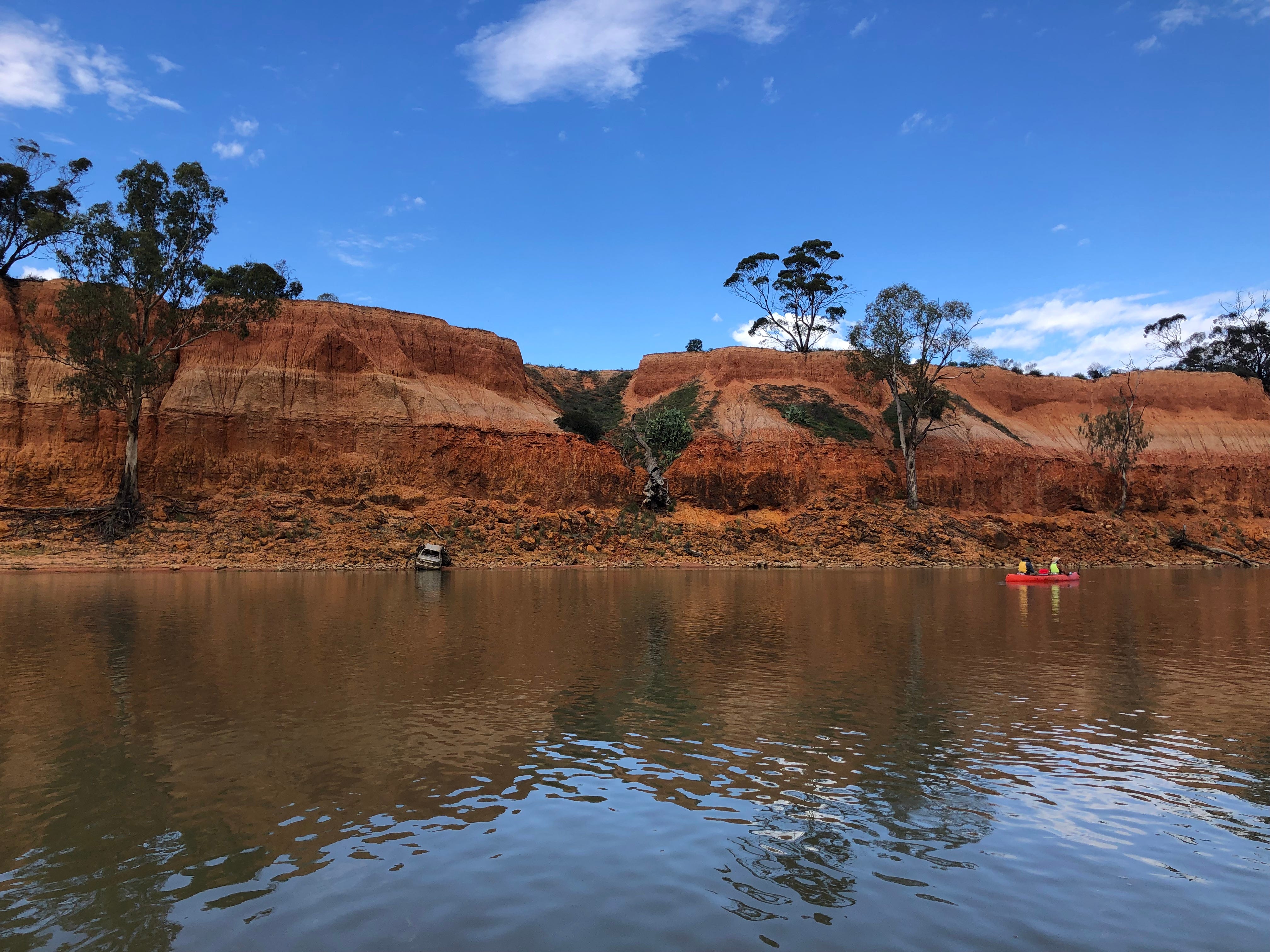
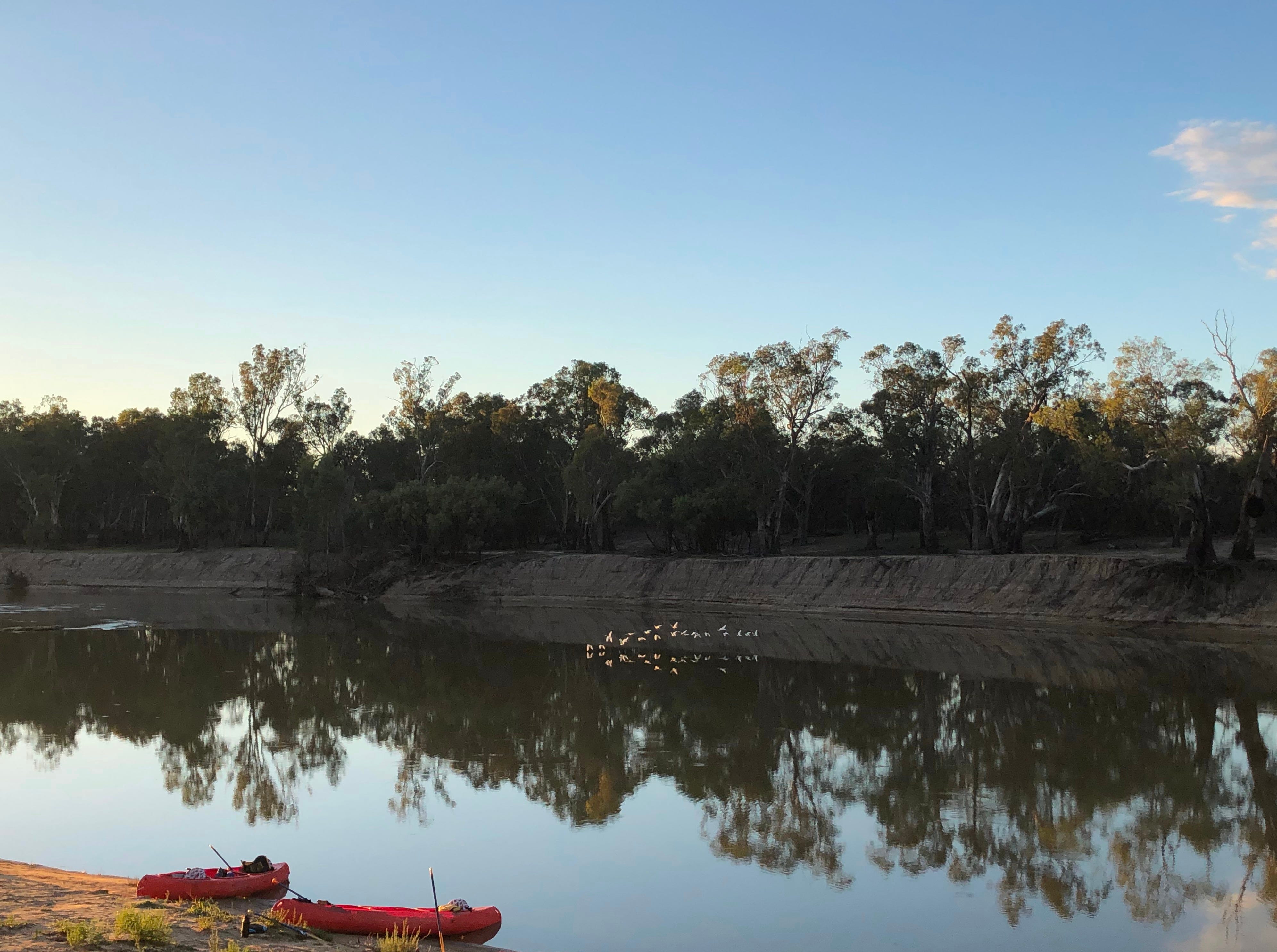
Before heading down the Murray our group sets about finding our river feet. We practice paddling in pairs and manoeuvring around logs and rocks until ready to set off with the current towards the Darling-Baarka. For five nights, we have nothing but canoes, food, sleeping gear, a few clothes, the river and each other. We camp under the Milky Way each night and paddle some 90km, witnessing the beauty and brutality rendered along the riverbanks.
I allow myself to suspend pre-existing knowledge about rivers, trees, birds… even the language we have for these things. I begin to read nature in verbs rather than nouns, moments rather than objects. The palpable aliveness of the landscape asks to be encountered in relational and kinetic ways. Red river gums absorbing rain after a storm. Humidity breathing and petrichor vapours rising, hovering half a metre from the ground. Tiny lights of spiders’ eyeshine dotted across the damp forest floor at night.
There seems to be a whisper of wonder in the air, it’s not just me in awe of the sparkling spiders. Perhaps it reflects a growing recognition that data and policy alone haven’t been enough and that imagination and moral courage have a role to play too. We seem to be remembering that human innovation, across cultures and centuries, begins in the same place again and again: in wonder at the natural world and asking, ‘What if?’ Leonardo da Vinci’s inventions were guided by curiosity and close observation of bird wings and water. The Crystal Palace was designed by a gardener who closely observed and cared for the giant Amazonia lily at Chatsworth House. The nose cone of Japan’s Shinkansen bullet train was redesigned to mimic the beak of a kingfisher, for its ability to slice through air and water without a splash.
A cultural tide appears to be growing, pointing to wonder as a quality that can help us out of our modern polycrises. I recently attended an urban planning talk by landscape architect Daniel Jan Martin called Wonder Land, a compelling reminder of the awe-inspiring biodiversity hotspot of Perth’s greater metropolitan area at risk from development. There’s Transition Town co-founder Rob Hopkin’s Ministry of Imagination podcast which invites guests to marry policy creation with radical imagination. In his 2023 speech at the Nature Conservancy Nature Writing Prize, Tim Winton pointed to a decades-long hole in Australian literature where nature has been absent. Wonder and words might not make a difference all the time, he adds, but sometimes they do. Winton’s own work and words exposing the plight of Ningaloo Reef is a case in point. More recently Natalie Kyriacou shows how wonder is an antidote to despair in her book Nature’s Last Dance: Tales of Wonder in an Age of Extinction.
The Milky Murray is a tale of wonder. On day three we drift into Pound Bend. Here the river is an amphitheatre. It is wide and bends just enough to create a momentary sense of containment, straight on one side, a curved bank on the other. The acoustic quality is particular, surrounding us, rather than disappearing downstream or into the sky.
By now I’m primed to notice. The first thing I notice is the tree. A red river gum in the company of others but none like this giant, four or five hundred years old. I observe her height, width, the nobbly brown protrusions breaking the bark. The gum-green leaves soft in the diffused daylight. There’s got to be at least a handful of holes where numerous animals make home. There’s a build-up of leaf litter at the base and bark hangs low on the trunk.
By now other canoe duos have quietly gathered. We all seem to know that this is the mother tree; the most connected node in a forest, according to ecologist and author Suzanne Simard. They are the nerve centre, connecting and supporting the next generation of saplings via an expansive underground mycorrhizal network, where they share their excess carbon and nitrogen. It’s a kinship that goes back into time. She stands tall, a few metres back from the banks which, here, are relatively stable and soft, compared to the fast moving erosion cleaving hard lines into so much of the riverbank elsewhere. So, she is spared, for now.
As we quieten, the second thing I notice is a deep, low sound. A hooooooooooo emanates from in or near the mother tree and seems to expand forever in all directions in one continuous note. An overlapping sound is coming from across the river. A third from somewhere else, who knows, because by now the sound envelops us, reflecting off surfaces: water, banks, trees, me. A gentle, calming sound bath. An owl, maybe.
I am a creature of the river now, resting in a moment of safety.
There is fascinating research emerging that helps to explain my sense of calm. What many of us feel, and many cultures have long known, now has a body of evidence behind it. In Japan the practice has a name – shinrin-yoku, forest bathing – and its own hospitals where practitioners prescribe slow, attentive walks among trees. Not exercise. Not destination. Just time, given carefully to the forest. The findings are striking: reduced stress and pain responses, lower inflammation, and increases in the lymphocytes our bodies use to fight virally induced cells and tumours.
What is especially striking is there may also be a connection to wonder and imagination. Natural sounds, birdsong especially, have been found to trigger alpha waves, that is, the same brain state present in the moment just before an idea forms. A state between relaxation and focus: a receptive edge. These alpha waves work in two directions at once, stimulating imagination while also damping the internal chatter that crowds it out. More than restoring us, the river may have been quietly preparing us. Loosening something, making room.
I made room through a rarified river experience. Many have trodden a different path. Farmers often face drought, fire or bankruptcy before asking, ‘Is there another way?’ ‘Am I doing right by my land?’ This is the starting point for many Australian farmers who have transformed their land management practices, and are demonstrating how landscapes can be regenerated in ways that are not only good for those landscapes but also for businesses, families, communities, and for a more resilient national food supply. I’ve sat across kitchen tables with enough of those farmers to know that the shift rarely begins with data alone. Some call these farmers ‘regenerative’. They are the innovators who took a leap of faith when ‘regenerative’ was a dirty word at the pub and they asked, ‘What if…?’ They dug deep, sometimes questioning their identity, often questioning their relationship to the land, undoing, remaking.
Charlie Maslin is a grazier on the Monaro in the Snowy River Catchment, whose name is now a byword for such seismic shifts in approach. For him the first shift came in the 1990s after a decade of managing the family farm Gunningrah. Charlie could see the limitations of the existing management approach and started asking whether the ‘bare ground was just a result of what happens during drought’or a ‘symptom of management’. From these questions and observations, he began to change his approach from managing animals to looking after the landscape that supports those animals.
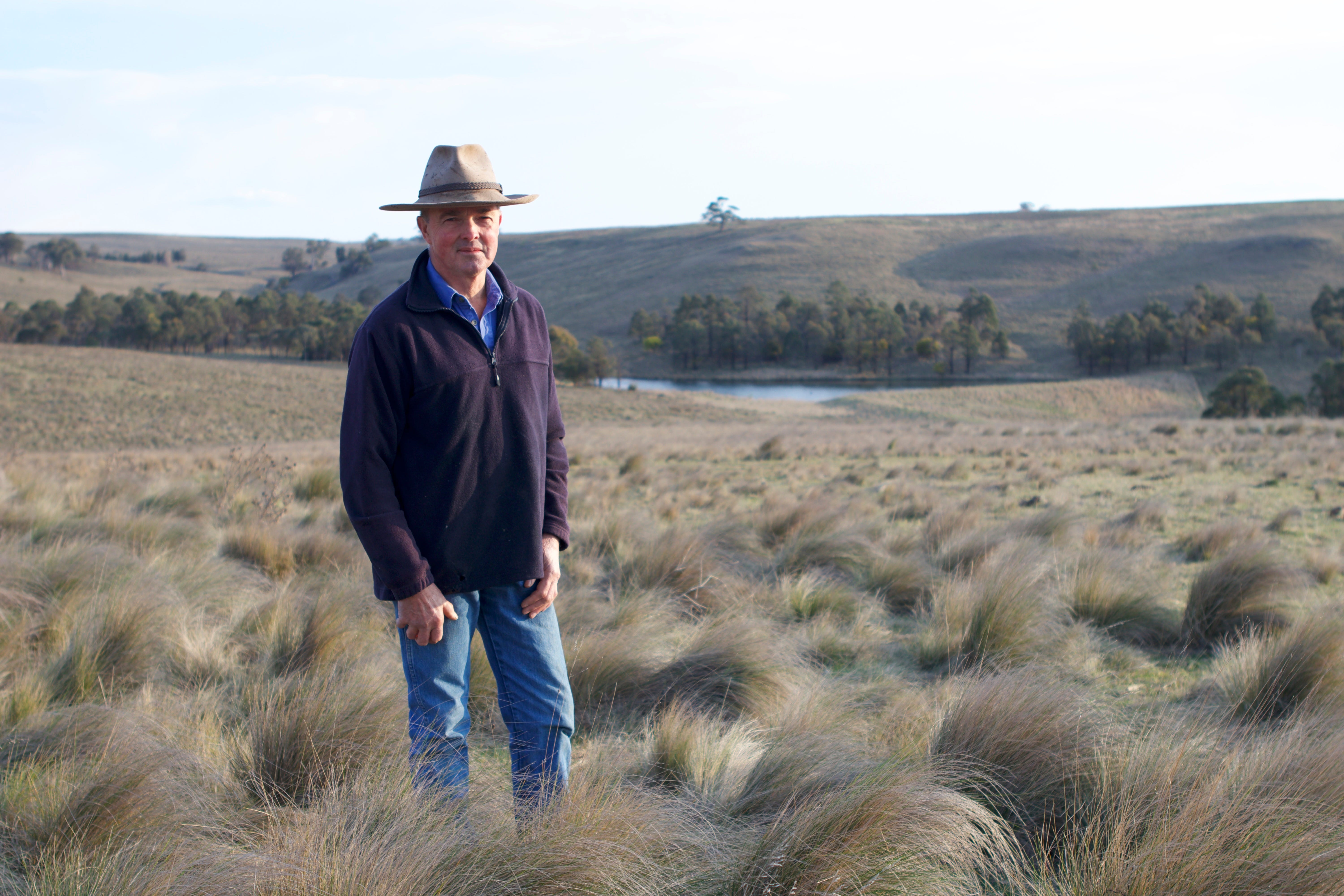
The innovation followed and continues. Charlie started by increasing the percentage of ground covered by plants and allowing paddocks to rest between the stock’s feeds. He then became curious about how water moved through the landscape and started work to slow the flow of water and increase the capacity of the soil to hold more water. Gunningrah turned around quickly with improved pastures and animal health first, followed by more consistent flows of water and a reduction in erosion that had characterised the property. Charlie now has a healthier landscape that is more drought resilient. It bounces back quicker after dry times, groundcover has increased from 65% to 90%, native grasses are thriving, there is greater water retention in more of the landscape, and production and profit have stabilised. Water quality has also improved along with the number of animals that rely on the water to thrive. Charlie has observed in one creek fourteen platypus holes, and across Gunningrah bird and frog life is now abundant. ‘If you can get those outcomes in this dry continent of highly variable rainfall, I think it’s a good thing,’ says Charlie (read the full Soils for Life case study). His success with restoring natural water cycles began with wondering, by questioning management strategies that followed the status quo, and with close observations of the water, the animals and the landscape. Not all landscapes are so lucky to have the careful attention of Charlie.
On the river one afternoon a few hundred meters from camp, the water cycle came at us in a torrent. Unannounced on our weather apps, a storm cell threw us about. One canoe almost capsized as the waves came hard against the current. It was a baptism of sorts, another moment of awe that enlivened us all. As the rain hammered the surface I thought about where it would go: into the river, into the soil, deep into the aquifers that lie unseen, into the plants, into the air again. As Charlie has shown, healthy soils covered in diverse vegetation absorb more rain when it does fall, slowing its journey and feeding those underground reserves rather than losing it to runoff. And these landscapes produce their own rain. Research shows that when vegetation transpires, the water vapour carries bacteria and volatile organic compounds that recharge the moisture in the atmosphere, promoting rainfall. Just imagine this at scale. Landscapes that hold and cycle water, replenishing rivers and aquifers alike, stretching across the Basin and far across the country.
Back on the river later, in a state of openness and calm, I study the devastating marks of our extractive industries on the riverbanks. The drains sucking water from the Murray at a rate I’m not sure the river can maintain. The dry eroded riverbanks, raw with an absence of groundcover and the wounded topography of exposed gnarly tree roots. Not all the red river gums are just holding on, some have fallen in, leaving parts of the river looking like a battlefield. After five days of seeing these trees and roots, we have to stretch our imaginations far to envision the banks before this mess. We also get a sense of the type of imagination we will need to find our way out of the mud.
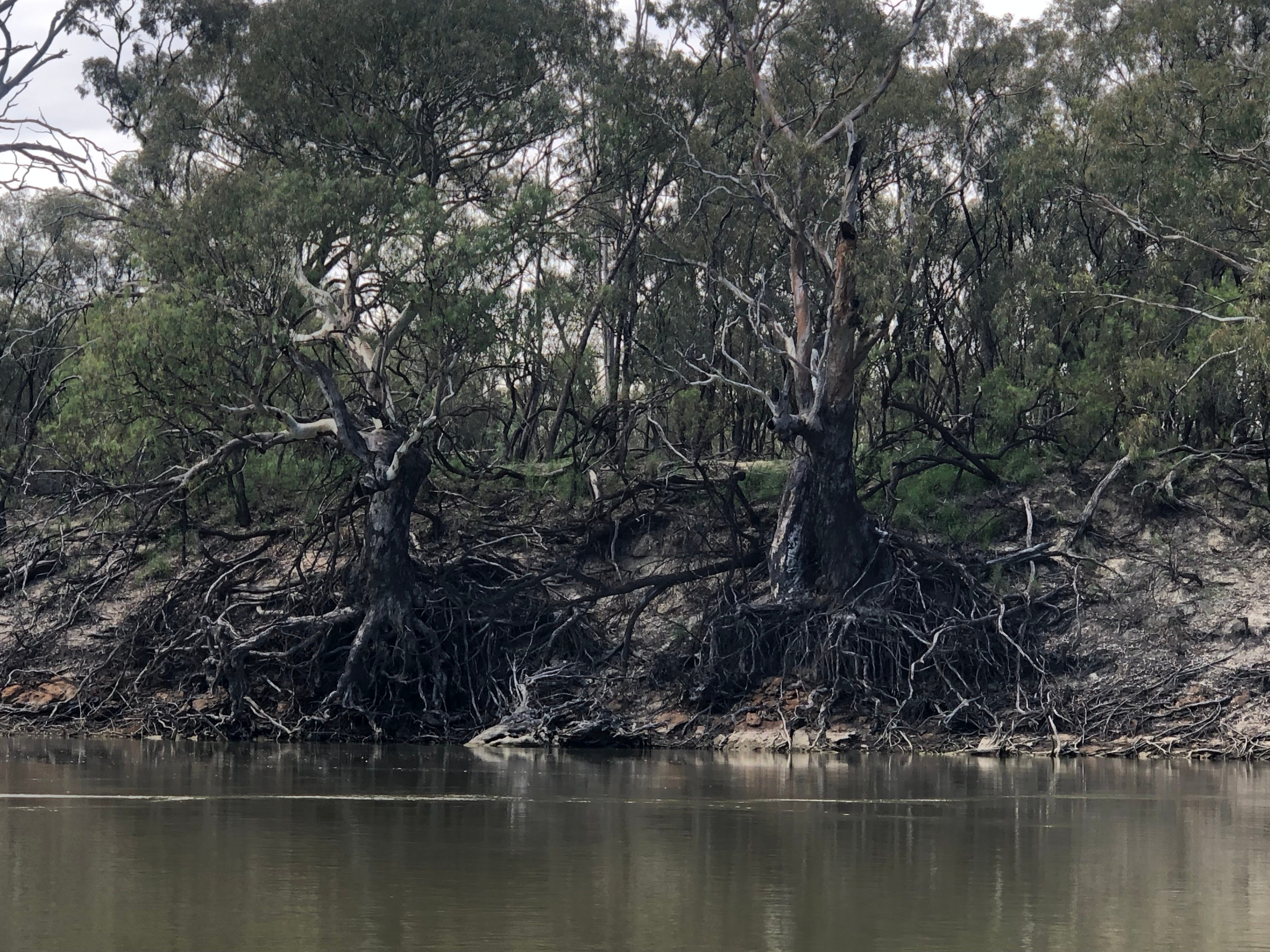
It is here that I feel most acutely the gap that Winton identified in his prize speech, through the words of the economist Justyn Walsh he drew from, who described ‘a nature-sized hole in the heart of mainstream economic theory… that fails to value the natural world.’ Sitting with these dying trees, that hole is not abstract. It is what happens when the river is resource alone.
Chief executive of the Murray-Darling Basin Authority Andrew McConville recognises the mammoth safeguarding ahead for protecting a healthy future for the Basin. ‘We are going to have to use the water we’ve already got well.’ One of the greatest tasks required for knowing how to proceed with usage, is to first sit with the unknowing, to open up space for imagining what the Basin might look like, could look like, if the water is indeed used well. How the banks could be soft and covered in vegetation, the soils spongy and absorbing the rain. This challenge is not so much a challenge of technique or data. Examples like Charlie Maslin’s across Australia in diverse landscapes are now abundant and convincing, not only at a farm scale but also at a whole landscape scale. The challenge seems to be one of wonder, of our ability to ask, ‘What if?’
To wonder with immense imagination doesn’t mean anything goes. The Milky Murray needs some guardrails: a wonder rooted in principles. I recently read Robert MacFarlane’s ‘Is a River Alive’. The book title and subject itself demands a kind of wondering, an inquiry into the nature of existence, alternate futures, ethical obligations. Through poetry and prose Macfarlane recalls his visits to Los Cedros cloud-forest in northern Ecuador, a country he was compelled to visit for its ‘vast moral imagination [that] changed the world’. He is referring to Ecuador’s 2008 Constitutional changes that enshrined the Rights of Nature, the legal rights of ecosystems to exist not as property but as entities with rights to existence, flourishing and restoration. That turn of phrase, ‘moral imagination’ captured my attention. It sounds as if moral imagination were a precursor to change.
Perhaps exercising our ethics is imperative sitting alongside our capacity to wonder. When thinking about the future of the Milky Murray, the Rights of Nature may be one way to stretch our moral imagination via a solid legal and moral framework. Rights of Nature may seem esoteric at first, yet conferring a right to a river acknowledges the very material fact that water is life. There may be other ways to stretch, and the river communities themselves, including the First Nations voices gathered in Water is Life, may be our best guide.
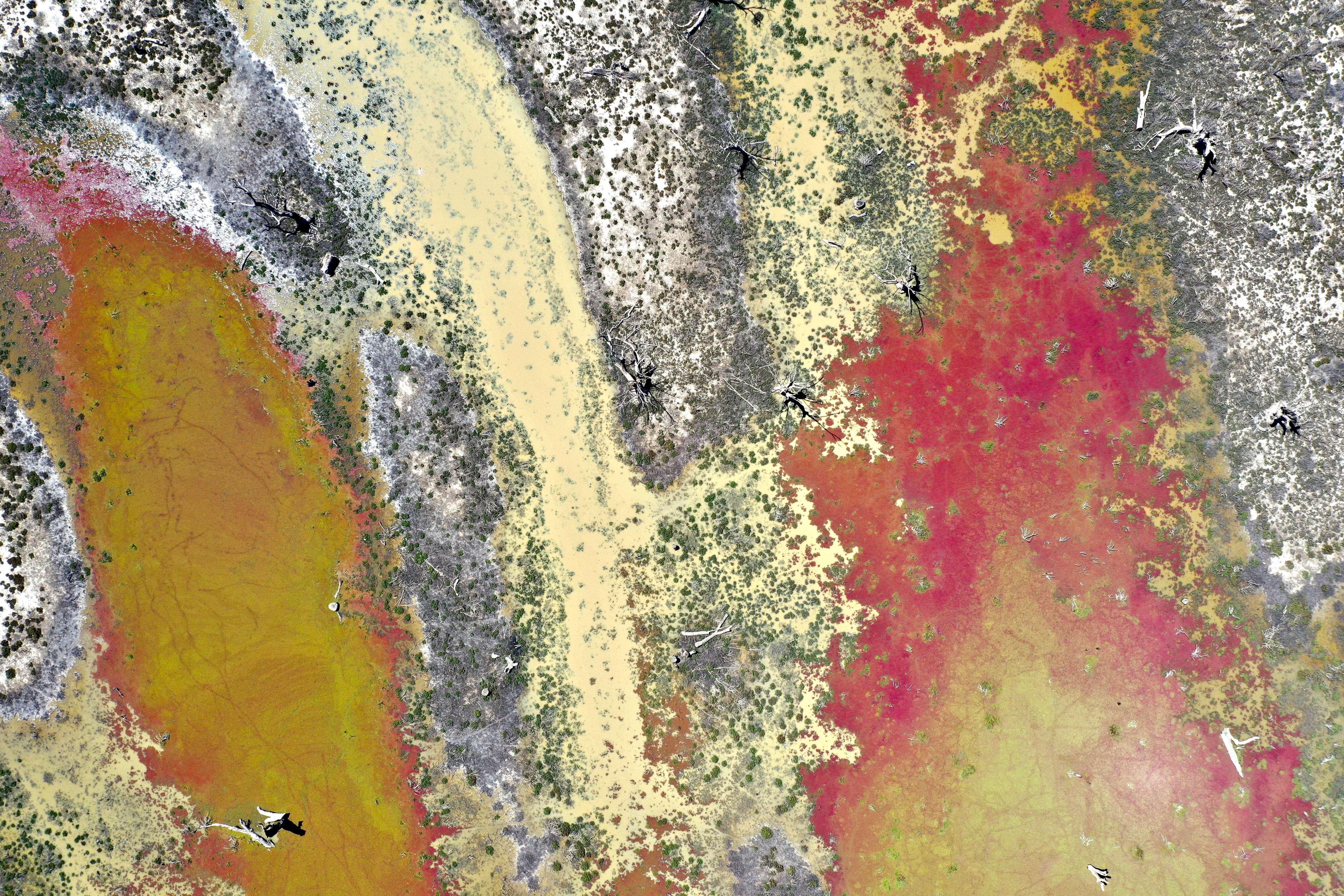
The Milky Murray holds a lot. Silt and algae, the vulnerable and venerable Murray cod and the proliferating carp, warmth and cool, light and shade. It carries the weight of stories – joy, connection, rage, heartache and the long shadow of what has been taken. It carries the weight of industry. Our approach to its management need not be as narrow or rigid as the dominant story of the river as resource. It can stretch as far as our imagination, ethics and courage allow.
We all have to come back from the river of wonder at some point. By the time I go for my last swim in the Murray, we’re in Robinvale again. My hair is chalky and dry and I’m covered in a coat of suncream, sweat and who knows what else. I still can’t see through the cloudy water. The Murray is still Milky. But something has loosened. I am full of tenderness and wonder. The organising principles of my busy life quietly fell apart and were remade as a space closer to the living world I’ve spent a lifetime trying to protect.
Thank you to Isabel Johnson, Gary Cox, Cynthia Mitchell and Katie Ross for their editorial input.
So good Kate - full of wonder, love and care ❤️ Thank you for taking me back to our wonder-ful time together 🔆💦🍃🙏
Love this bit Kate, thank you